Saturday, 21 November 2015

PEGAMINA PART SEVEN


PEGAMINA
By BARRY VAN-ASTEN
 
PART SEVEN
 
THE REMARKABLE NONSENSE BIRD

The sunlight fell through the trees like a beautiful river of golden beams as Pegamina awoke, and she could see through a clearing in the woods the distant shapes of the landscape, all grey and green and sad and lonely. She thought to herself how haunted it all seems, not in the frightening way, but in a strange and romantic sort of way that one often finds in dreams; where everything is so ancient and so full of sorrow. It seemed to go deep into her heart as she stood there at the edge of the wood, looking at the rolling fields and ruinous woodland before her.
While she was deep in these thoughts, she noticed a small bright object on top of a hill, not too far away, but she was unable to see quite what it was. After walking for some time, the light on the hill became brighter and brighter. ‘I wonder what it is?’ she thought to herself. Climbing up the hill she could suddenly see what the bright object was, for there, at the very top of the hill, was a small ball of fire, and it seemed very unhappy!
‘Who are you and why are you so sad?’ inquired Pegamina of the bright object.
‘I’m a star and I’m sad because I fell from the sky!’ it replied.
‘That was very careless of you, wasn’t it?’
‘I know! I’m not a very bright star, in fact, I’m rather dim and clumsy; I’m always bumping into things!’ the star said in some distress.
‘Silly little star. How I wonder what you are!’ laughed Pegamina.
‘Please don’t make fun of me, it hurts and when I’m hurt I lose a little of my twinkle!’ And the star sobbed.
‘I’m sorry. I didn’t mean to hurt you. Is there no way for you to return to where you came from?’
‘I’ve thought ever so hard about it, so hard that my light has grown dim, and now I don’t know what to do!’ said the poor star with tears in its eyes.
‘Don’t cry star. I will help you, I promise’. And with this the star stopped crying and said ‘you’re very kind, but I don’t know what anyone can do for me!’
Pegamina sat beside the star and thought a very long time over the problem. And every so often, the star would look to Pegamina, as if expecting some answer, but no answer would come. Pegamina felt sad for the star and all she could say was ‘it is so very far away, isn’t it?’
As the shadows lengthened and day was slowly turning into night, they were both startled to hear the sound of singing coming from the woods:
 
‘Have you ever seen such a marvellous fowl?
Have you ever heard such a fearsome growl?
Grrr! Grrr! Grrr! Grrr!
The greatest phenomena in feather and fur!
From the tip of my nose to the ring on my toe,
Talking nonsense wherever I go, don’t you know!’

Now, this odd-looking creature that had been singing was now walking backwards at a fantastic speed up the hill like a steam engine, towards Pegamina and the star. Not noticing the little star, the backwards-walking creature sat upon the poor star’s face and began to read its book!
‘I think you’re on my face!’ said the timid little star.
‘Your face?’ replied the odd-looking creature.
‘Yes, my face’.
‘Oh excuse me I thought it was someone else’s face!’
‘I can assure you it is my face!’
‘My apologies!’ and the strange backward-walking creature stood up only to sit back down with greater force upon the star!
‘Do you mind!’ said the star through its flattened mouth.
‘Oh, was that your face again? I thought it was a bit warm!’
‘Still my face!’
‘Then may I suggest that you remove it from my posterior at once sir, at once... my posterior, sir’ said the strange creature, pointing to its tail. ‘Your face, sir’ it said, pointing to the star. ‘Worlds apart, sir, worlds apart!’ It boomed, expressing the distance with its hands before returning to its book.
‘I think you’re very rude! Who do you think you are?’ said Pegamina quite defiantly. And the creature stood up, releasing the star, and said:
‘I am the remarkable nonsense bird. I have five legs, count them: one, two, three, four and five; and look, one toe. How do I know? Look again!’ and the bird raised one of its five legs to reveal a beautiful toe that was wearing a ring of gold with a sparkling emerald set into it.
‘That’s a beautiful ring!’ said Pegamina, admiring it.
‘Ah yes, but look at the toe, look at the toe; isn’t it the finest toe you have ever seen?’
Pegamina never answered, for as far as toes go, one looks much like another. And so the nonsense bird sat next to the star and returned to its book.
‘What is the book about?’ Pegamina asked, feeling a little awkward.
‘It’s about half-way through!’ answered the nonsense bird.
‘But there are no words in it!’ said the little star, feeling brave.
‘That’s because it has nothing to say!’ then the nonsense bird began to sing:

‘I will not reverse into a world
That is not prepared for me;
I go backwards to see where I have been
Don’t you see, don’t you see, don’t you see!’

‘I think you’re very noisy for such a small thing’ said Pegamina.
‘Nonsense! Don’t you know that noise is silence, only louder!’
‘What silly things you say!’ Peg said wearily.
‘Yes, but I can see in your eyes that you are head over toe in love with me. Oh say you’ll be mine and toe-gether in good and fowl weather, we’ll go to gather wild bluebells and heather, with sweet hand in fine feather, for ever and ever...’
‘No never! No never!’ screamed Peg.
‘Never? What never?’
‘Never! No never!’ And the nonsense bird swooned:
‘O heartless beauty, I die before you. My bruised heart crushed with a careless word; has not a nonsense bird feeling? Has he not two eyes, five legs and a toe? Ohhh, ohhh I am a broken-hearted bird, broken by a careless word! I offered her my love and the use of my toe, to hang pretty things on and still she said “no”. And in time, many will come to this hill and stare at where the remarkable nonsense bird gave his life for a beautiful girl who did not care to be the remarkable nonsense bird’s remarkable nonsense wife!’ And the nonsense bird fell, as if dead, to the ground in one of the greatest and longest performances ever seen in theatrical history, crying ‘I wash my hands of love!’
‘Birds don’t have hands!’ Pegamina said to the pitiful sight of feathers and tears lying on the ground before her, to which the nonsense bird sprang to his feet and said:
‘Oh yes, some handsome birds have some hands and some gruesome birds have yet to grow some!’
Pegamina looked at the nonsense bird and began to feel sorry for it. After all, it can’t help talking complete nonsense, it’s what it does. So Pegamina apologised for hurting its feelings and the nonsense bird said sorry to the star for sitting on its face. Now, surely between the three of them they would find some solution for returning the star to its proper place. And so Pegamina explained the star’s distressful situation to the nonsense bird.
‘How very perplexing, said the nonsense bird, walking backwards in a circle, ‘and how fortunate for you that I should happen to come this way! Now, I shall have to apply all my scientific knowledge to the problem, of course.’
‘Oh of course’ Peg said, letting the nonsense bird feel very important indeed.
‘Let us take the astronomical point of view. Now, our sad, spherical friend here, who has not the sufficient propulsion, nor I might add, the intelligence to return to his celestial orbit, wishes to do so, correct?’
‘Correct!’ answered the star and Pegamina together.
‘Now, if we apply the laws of physics, we can see that his mass is greater than gravity, and there is no way of changing his weight or his dimension for that matter, agreed?’
‘Agreed!’ answered Pegamina and the star.
‘Then let us take the mathematical stance. Logic tells us that by taking the locomotive radius and multiplying it, thus creating an arc of forty-five degrees, one is able, theoretically, of course, to predict the positive energy one needs to propel such an object into motion; and by subtracting the combined mass and adding the total to the molecular structure of the body, in its inert state, of course, the negative will, I calculate, be transformed into a positive flux and thus resolve itself in flight. Of course, one has to divide the horizontal factor by the vertical, that’s very important!’ And here the nonsense bird drew a line in the ground with its toe to demonstrate his theory.
‘That’s all very clever and we are not all blessed with your intelligence so could you make it a little clearer so that we can understand?’ asked Peg, a little bemused.
‘Well, to put it another way – upwards!’
‘Are you saying that it is possible?’ said the star with a faint smile.
‘Oh yes, it’s all a question of advanced mechanics and aeronautics. But let us not forget that it’s also necessary that the wind should be favourable and blowing in the right direction!’
‘And how will we know when we have the right direction?’ Peg said with a yawn.
‘Simple! I stick my toe in the air, thus!’ and the nonsense bird raised one of its five legs a wiggled his toe in the air.
‘It all seems very scientific; couldn’t you make it a little easier to understand?’ Peg said again.
‘Haven’t you heard anything I’ve said?’ the nonsense bird squawked.
‘Oh yes, but we don’t have your great learning, do we star?’ and the star giggled.
‘Well, to put it in simpler terms: what comes down, must inevitably, go up!’
‘How?’ cried the star.
‘How?’ yelled Pegamina.
‘Simple!’ replied the nonsense bird, ‘the star will climb upon my back and I will fly into the air!’
Pegamina clasped her hands and jumped into the air several times, shouting ‘nonsense bird, what a marvellous bird! Have you heard, have you heard of the nonsense bird? From the tip of his nose to the ring on his toe, talking nonsense wherever he goes, don’t you know!’ And the nonsense bird blushed and smiled at Pegamina as the star climbed upon his back with the biggest grin you ever did see!
‘Hold on tight, star!’ shouted Pegamina.
‘I will, and thank you so much! Remember, whenever you look up into the night sky and see my twinkle, you must know in your heart I am twinkling for you and you only!’ Pegamina flung her arms around the star and the nonsense bird and wished them a safe journey, and before she knew it they were both in the air. The star smiled at her as he became brighter and brighter and higher and higher they flew. And the nonsense bird turned his head towards Pegamina and shouted:
‘Look at the toe! Look at the toe! Look at the...’ and they were both gone.


Have you ever seen such a marvellous fowl?
 

PEGAMINA PART SIX


PEGAMINA
By BARRY VAN-ASTEN
 
PART SIX
 
THE SERMON ON THE MOUND

It had been a long day, and as the day grew into night Pegamina, finding no place to rest, decided to wander a little from the track she had been keeping to. She hadn’t wandered very far when she heard the sound of raised voices which seemed to come from behind a stone wall. As she crept silently towards the wall, the voices began to grow louder until she could almost hear what was being said, though not quite, for the sound of a flowing river seemed to half drowned out the voices.
As she peered over the wall, she could see what all the noise was about, for there, by the side of the riverbank was a small collection of odd-looking creatures, all sitting around the side of a grassy mound, on top of which, stood a very important looking bird, a raven in fact, waving its wings and stamping its feet in all directions. And as she looked about the scene before her, she noticed by the side of the river, paying no particular interest in what was being said, was the unspeakable toad in all his glorious unspeakableness, flat on his back and demanding in full voice the traditional treading, quite oblivious to the fact that he was being enormously ignored.
Without being seen, Pegamina climbed onto the stone wall and lay down upon it as quietly as she could and listened.
‘Furthermore’ croaked the raven ‘did not this flame burn in the days of two moons!’ And here the raven began to quote a strange passage from the holiest book in Sleepy Sadness known as The Pense or The Dense, which begins:

‘The noble knight nuffs his nade
In quanerous rodells by the lade.
Slurping Goodbar – jatacasted,
Tome Slanty, the gurlet, purdoranced.
Undew norns did slapeless, wadelgrabe,
Through dripping, guey, Noggin Slabe;
Where Ular bellowed: “Boll Berwick’s Bruste!”
Upon Mount Zosta, the Wibble’s Puste!
Run rackled, begulfed in momulous grief
And entant the sloven, wooly reef.
Nitter, natter, the bewilderous things;
Toadish brines by eternal springs.
Yimmer, yammer, the moondish flats,
Osgan Moord, contentus grats;
Bagal, finial, rugged rand, and
Slip slither, silty sand!’

Now, I should point out that The Pense or The Dense is considered to be the holiest of books ever communicated by the Superior Being known as the Ancient. It was received after the dawn of time by an unknown prophet who spent his life teaching that which was divinely given to him. But unfortunately, the prophet was as deaf as an old pair of boots and could not be sure whether the book was to be known by the title of ‘The Pense’ or ‘The Dense’. And so it came to be known as ‘The Pense or The Dense’. The book is written in the style of an epic saga. Telling of how wars were lost and wars were won, and it gives an excellent account of noble deeds and acts of treacherous villainy. In fact, it is a complete history of Sleepy Sadness and its surrounding villages. Tradition has it that there were a further nine volumes originally written, but only the first has survived, which alone takes a lifetime’s study, and so most serious students can do no more than browse through its incomprehensible contents. Kingdoms have been won and lost between those who refer to it as ‘The Pense’ and those who know it as ‘The Dense’. And even now, scholars are disclaiming its authority as the word of the Ancient on the grounds that the prophet, being stone deaf, must have misheard and misspelt most, if not all of the book, and so it is therefore unreliable, and some would say unreadable. But still it continues to be the most revered and worshipped object in Sleepy Sadness.
‘Furthermore,’ croaked the raven once again, ‘I come not to you, but for you. I ask not that you shall follow me, only that I shall lead!’ And here, he began to recite the parable of the crooked man:
 
‘In a crooked room, there lived a crooked man,
And in his crooked dreams, he dreamt a crooked plan:
He dreamt a crooked man could fly, far from this crooked earth
And crooked eyes looked on the light dimmed by his crooked birth.
He walked across the crooked floor and around the crooked walls
And to the crooked table where the crooked curtain falls,
Where there stood a crooked book full of crooked words
And little crooked pictures of little crooked birds.
Sat by the crooked window he watched the crooked sky
And asked the crooked question why a crooked man can’t fly.
He searched his crooked heart and found the reason why:
A crooked man has a crooked soul so a crooked man can’t fly!
But the crooked man had one desire since he was a crooked boy:
He had to know within himself if a crooked man could fly!
So in a suit of crooked feathers he drew a crooked breath
And the crooked man leapt from his room and to his crooked death!’

By now Pegamina was becoming quite sleepy and found it difficult to listen to what was being said. Only small snatches of words seemed to reach her ears between the sound of the rippling river and the wind blowing in the trees. And only distorted images of the raven, flapping its wings and stamping its feet upon the mound, seemed to enter her tired eyes.
As she lifted her heavy eyelids, first one then the other, she could see that all that was left of the strange gathering around the mound were just a few noisy shapes in the moonlight.
‘...and we are merely wished into a world we no longer wish to participate in. It is ourselves; our very selves, with all its desires and pains and infantile fancies that cause this everlasting sorrow. For let us not forget the words of the Ancient: “It is in the mystery of the heart where sorrow’s seeds are sown, and it is in the cradle of our tears where sad seeds come to bloom!” And furthermore...’ she heard between the river and the wind. But she had fallen fast asleep.


‘Furthermore’ croaked the raven

PEGAMINA PART FIVE

 
PEGAMINA
By BARRY VAN-ASTEN
 
PART FIVE
 
THE ELUSIVE SINGING BUTTERFLY

It was early the next morning when Pegamina awoke to the shafts of sunlight entering through the windows, giving the room an other-worldly glow. As the last curtains of sleep fell from her eyes, she sat up and looked about her – there was the music box, still on the bookcase, and there were her shoes on top of the shelf by the fire. But how awful the room seemed in the sunlight, its decay unmasked for all to see! Could there ever have been joy here? Across the room great chains of cobwebs fell and everywhere that Pegamina looked there was a thick carpet of dust eager to blot out every reminder that this room had once known life. Yet nothing could live here now; this is a dead room! How very different it all seemed the night before. ‘The darkness does hide the things one doesn’t want to see’ thought Pegamina as she sat by the window, looking at the wild green landscape stretching out beyond the yew trees that had been so frightening in the darkness. Now everything was calm and still, yet Pegamina felt confused: ‘had it all been a dream?’ she thought. And not wishing to stay any longer, she hurried from its dim walls and depressing air, out into the sunshine – ‘Let it keep its secrets’ she whispered to herself.
She had walked for most of the morning and was beginning to feel rather hungry. As she turned a bend in the lane, she noticed a large stone monument in the middle of the crossroads. It didn’t seem to be of anything in particular, just an ordinary stone column with some words written upon it. Pegamina walked towards the column and read the words out aloud: ‘In memory of a thin man’ and she read on:

‘Here lies one, whose soul was meek,
He ate, but only once a week;
He grew so frail, he could not stand:
He weighed but fifty grains of sand.
 
And if in life you should meet
A man so disinclined to eat:
Don’t cough, don’t sneeze, don’t say “Good Day!”
For you shall blow him quite away!’

‘How strange’ thought Pegamina as she sat down against the stone column to rest a while;
‘Don’t do that!’ came a voice from somewhere.
‘Don’t do what?’ replied Pegamina, jumping to her feet.
‘Don’t pity poor thin man for he is dead – he left too many things in his heart unsaid!’ And just then, an odd-looking bird-like creature stepped from behind the column and introduced itself:
‘I am the Don’t Don’t bird don’t you know and I’m pleased to make your acquaintance’ it said in a gruff voice, bowing so low that its nose touched the ground.
‘My name’s Pegamina, how do you do?’ she said a little nervously.
‘Exceedingly!’ was all that the Don’t Don’t bird replied.
Now, to give a description of the Don’t Don’t bird would take so long that by the time you’ve understood what it was in the end you would have completely forgotten what it was in the beginning, for it was such a fascinating and unusual bird in its appearance. But briefly, one could say that its head was of the exotic sort: too much beak and not enough eye! (I must mention here that the Don’t Don’t was somewhat disadvantaged in the eye department, in fact, he had decided at an early age that one eye is quite sufficient to see the world and to have two seemed positively greedy, so out came the eye!) its feathers were sometimes black and sometimes blue, for they seemed unable to agree on one colour. Its legs were long and thin and its feet were three sizes too big. And the whole ensemble was carelessly thrown into a pair of ancient golfing trousers and a red hunting jacket. And upon his back he carried a pink ruck-sack with a shotgun strapped across it. And all this could be seen pacing up and down before Pegamina, looking a little flustered.
‘What are you doing?’ asked Pegamina.
‘I’m waiting’ replied the Don’t Don’t.
‘Waiting for what?’ ‘Not what – whom!’
‘Then for whom are you waiting?’
‘Peacock!’ said Don’t Don’t, almost singing it.
Pegamina didn’t like to ask why he was waiting for the peacock, although she would have liked to have known. She sat down and feeling a little weak from being hungry, she said:
‘I don’t suppose you have something I could eat in your bag?’
‘You can’t eat in my bag but I have something in my bag that you can eat!’ returned the Don’t Don’t. And he reached into his ruck-sack and pulled out a big red apple and said:
‘You may take this apple with my compliments’ and he bowed once again, just as low.
‘Thank you, you are kind’ said Pegamina accepting the apple.
‘Tell me, why are you sitting at the monument; are you waiting for someone too?’ inquired the Don’t Don’t.
‘No, I’m only resting, you see, I have become quite lost and don’t know which road to take’.
‘Don’t take that one!’ said Don’t Don’t, pointing, ‘it goes nowhere, which is all very well if you want to go nowhere, but if you want to go somewhere, then I would take that road’ and he pointed once again. But Pegamina didn’t really understand where somewhere was and why it was better than nowhere, but she supposed it was better than here or anywhere.
As she sat eating the apple, she forgot all about the Don’t Don’t bird and thought only about her ghostly visitor the night before. Why was he occupying her thoughts so much? In her mind she saw how kind he had been to her and how very lonely he seemed in that crumbling time mill. She thought how, for the first time in her whole life she had looked into someone’s eyes and found more than pity for her own sorrows; more than the cruel thoughts that hurt so much and cannot be hidden by one’s eyes no matter how hard you try. It’s like the sunlight, she thought, pouring in at the windows of that dark and dreary house; nothing can escape the truth and one’s eyes are like the sunlight, for no deceit can be hidden away by them. But she didn’t want these feelings, there was no joy in them, only pain, for the truth was she had fallen in love with a ghost!
As she wiped a tear from her eye, the Don’t Don’t bird, who, between keeping his eye out for the peacock and observing the sad, sitting figure of Pegamina, suddenly said:
‘Don’t cry little one! It is only the butterfly fluttering in your heart!’
‘What do you mean?’ said Pegamina, not understanding.
‘Don’t you know of the elusive singing butterfly?’
‘I’ve never heard of it!’
‘Dear me not heard of it!’ chimed the Don’t Don’t.
‘I’m afraid not. Will you tell me about it?’
‘Well’ began the Don’t Don’t bird, ‘a long time ago, when there was time of course, there was a great falling out between the night moon and the day moon’.
‘You mean there are two moons?’
‘There were, let me continue. Now, these moons, they had both fallen completely in love with a princess and her name was Caltrenia. She was so beautiful that all the young and handsome princes came to admire her beauty and ask for her hand in marriage. But the princess would never consent for she so very much liked having two moons fighting for her love that no mere prince could ever compete or be acceptable to her! Each night, she would sing from the highest window in the tower of the palace to the night moon and each morning she would play her harp to the day moon, for she could decide between them. But her father, the King, grew more and more unhappy, for the land was plentiful with prosperous and well-connected young princes, yet his daughter who despised all earthly riches, would have none for a husband! So the King sent word throughout the kingdom that whoever could rid the land of the day moon, that man, no matter his status or his finances, shall take the hand of his daughter in marriage. Well, as you can imagine, many tried and many failed and the King grew more and more anxious, until one day, a man named Myther, not so very handsome and not so very rich, came and put a spell over the day moon, transforming it into a beautiful butterfly!’
‘And what happened next?’ said Pegamina, entranced by the story.
‘The princess married the man, though she did not love him. She tried with all her heart, yet still she could find no affection for him. Then, one day, she ran away from her doting husband and away from her father’s kingdom, in search of the butterfly that sang so sweetly. She searched and she searched but no trace of the butterfly could she find and she grew very sad and very old until she was never heard of again!’
‘What a terrible thing to fall in love! But tell me, has anyone ever seen this butterfly?’ said a tearful Pegamina.
‘No, it is elusive, but it can be heard, so I’m told, when one is deeply in love. Its soft, sonorous voice sings in the hearts of lovers. And I think it is singing in your heart!’
Pegamina said nothing as she felt the tears come to her eyes once more.
‘There is a song about the butterfly that is well known here, would you like to hear it?’ said the Don’t Don’t bird.
‘Oh yes, I would please’ Pegamina answered. And the Don’t Don’t bird began to sing:
 
‘O secret or symphony -
I know its heart too well;
Sweet sovereign of life's mystery,
Your silence cannot tell
What difference this is, parts you and I
Or what spirit takes you far away.
 
Will this love immense, never fade;
Could my heart but love you less?
I have seen your fiery wings displayed
To summer's silver light caress;
Serene, unfolds, and flits away
And blessed to live another day.
 
I'll say I'll seek its beauty,
To hear its sealed heart sigh
Through the long, lone summer,
Wherever its soft wings lie.
And passions fleeting in vain, will chase,
Though never mar nor seize its grace.
 
Since then in my remembering
Its sad and sable flush,
Fate, in its surrendering,
Steals by a pale moon's crush
Where the frailness of the butterfly
Unknowing strength - must die!’

Pegamina wept. ‘Perhaps it does sing in my heart after all!’ she thought.
‘Ah! Here’s Peacock now!’ shouted the Don’t Don’t bird.
‘Helloooo’ boomed the peacock, striding towards them with a refined air about it.
‘He’s a game old bird the Peacock, a positive enigma, I say a positive enigma to all who know him!’ whispered the Don’t Don’t bird in Pegamina’s ear.
Now, there was nothing unusual about the peacock except for a rather long scarf wrapped at least three dozen times its neck with the remaining ends continually getting under his feet and tripping him over. On his head he wore a top hat that was much too large for him and so he was forever pushing the brim up from out of his eyes. And on his back he carried an over-stuffed ruck-sack!
‘Up to no good I see Don’t Don’t! And what have we here?’ said Peacock, waving a wing in the general direction of Pegamina.
‘This is my new acquaintance dear Peacock, her name is Pegamina and she has the butterfly within her!’
‘Ahhh, so young and so foolish! Pleased to meet you!’ Peacock said, shaking her hand but looking at the Don’t Don’t bird.
‘I’m very pleased to know you’ she said, curtsying for he did look so distinguished.
‘Are you indeed? Then I’m sure we shall get on just fine, eh Don’t Don’t?’ and they both laughed, and Pegamina, not wishing to seem rude and unfriendly, laughed too.
‘Well are we all ready?’ the peacock said in a theatrical manner.
'We are so ready Peacock that there is a danger of expiring from over-readiness!’ chuckled the Don’t Don’t.
‘Ahh I see we’re in fine jest Don’t Don’t; one needs to laugh when one is so incredibly laughable!’ and they both laughed.
‘Ready for what?’ inquired Pegamina.
‘For the hunt! My dear, for the hunt!’ answered the peacock, emphasising the word ‘hunt’.
‘But what are you hunting?’
‘I don’t know... what are we hunting Peacock?’
‘Ahhh who knows when the sweet hunt is upon us!’ the peacock answered displaying a grand sweeping gesture with his wing and again emphasising the word ‘hunt’.
‘We may begin by shooting at the Lily, that’s always good sport! Or maybe throwing stones at the weeping trout, or then again, we could make another attempt at cracking the shell on the back of the giant shouting snail’ Peacock said gleefully.
‘But why?’ said a shocked Pegamina.
‘Why?’ said the Don’t Don’t.
‘Whhhhy?’ said Peacock.
‘Yes why? That’s not very nice at all!’
‘Nice’ said the Don’t Don’t.
‘Niiiice’ said the peacock. And he continued: ‘My dear, let me explain. We are sporting fowl. We hunt. It’s what we do’ he said, emphasising the word ‘hunt’ again.
‘I think it’s very cruel!’ Pegamina shouted angrily.
‘Cruel! Of course not’ said an astonished Peacock.
‘Of course not’ echoed the Don’t Don’t. ‘Besides, Peacock can fire away with both barrels all day long and still not hit a thing!’ Don’t Don’t whispered behind his wing.
‘I heard that!’ screeched Peacock, frowning.
‘And anyway’ continued Don’t Don’t ‘fishy likes stones thrown at it, it’s just like being tickled, only more fatal, you see. And as for the snail, well, its shell is un-crackable, but one must try, mustn’t one? It’s the love of the hunt!’
‘Precisely Don’t Don’t, the love of the hunt!’ Peacock interjected, again emphasising the word ‘hunt’.
‘I know what’s right and I know what’s wrong, and this is definitely wrong!’ Pegamina shouted, stamping her foot.
‘Good for you!’ said the Don’t Don’t, nodding its head.
‘Good day to yoooou’ sang the peacock and the two sporting fowl went on their way, contemplating the day’s hunt as Peg took the road to ‘somewhere’, thinking what wickedness there is in even those who know beauty!


Pegamina and the Don't Don't bird
at the Monument

PEGAMINA PART FOUR


PEGAMINA
By BARRY VAN-ASTEN
 
PART FOUR
 
THE SAD LITTLE GHOST

As Pegamina walked beside the winding river in the twilight, she thought about what the toad had said about the miller’s boy and his poor grandfather, the time keeper. Suddenly the air seemed to grow cold and it began to rain as she quickly crossed the bridge that was almost hidden by willow trees. In the distance, she could see the top of the clock tower rising above a small clump of trees which lay in a hollow, not far away, and as she began to run towards it, the rain ran down her face. A blustering wind seemed to appear from nowhere, and all along the dark lane she imagined that she could see things moving in the hedgerows. Faster and faster she ran until she came to the old time mill with its clock tower which seemed even more desolate in the darkness. And at each side of her the trees seemed to whisper: ‘go back!’ but Pegamina was tired and wet and wanted to rest and sleep until morning and forget the darkness that was all around her.
She found herself standing in the entrance to the mill, looking about her, at the shadows in the trees and at the black clouds descending over the ghastly garden that had been forgotten and run to weeds. As she stood for quite a while listening to the rain and the wind howling, she thought: ‘surely no ghost could be more frightening?’
The door was unlocked and she pushed it open, as its creak echoed down the dim, uneven passageway which lay like an open grave before her. Finding courage, she went inside and opened the door to the first room she came to. It was an old and elegant room, smelling of the past, and through its windows she could see the shapes of huddled trees that seemed to claw against the glass. Even in the darkness she some of its fine furniture and dusty heirlooms; there was a large bookcase full of rotten books; a cabinet containing a small collection of unusual objects. And a few upholstered armchairs, very worn and very tattered, lying like a herd of some long extinct species of animal around a table on which stood a carved wooden bust of a woman’s head, and more books, balancing precariously here and toppled into a heap upon the floor there. To her surprise there was a small fire lit in the fireplace and so she stood before it, drying her wet hair and giving no thought as to why the fire was alight. When she was dry she sat down upon the armchair, near to the fire and fell fast asleep to the sound of the rain on the window panes.
During the night, she found herself in that curious and helpless state between sleeping and waking, where nothing is as it seems and she could not remember where she was or how she got there. She looked at the faint glow of the fire and all around the room until it all came slowly back to her. The rain had stopped and in its place she thought she could hear the sound of someone singing. As she listened, it seemed to grow louder until she could make out the words of the song. It was a very sad melody sung by a very tearful voice:
 
‘Spider, spider, spinning tight
Threads of fury through the night!
In its black and gathered eye:
The destruction of the fly!
A silken web that shows to me
The spider’s fearful symmetry,
That fills my heart with so much dread
To see eight legs and a head
Spin so much and hear it spin
Strange and weird cathedrals in
The darkness where it’s fancy wills
Great monuments of archway frills!
Spider, spider, spinning tight
Threads of fury through the night!’

Pegamina was afraid, but not so afraid that she wanted to scream, just hide herself away in the darkness and not be seen. But there was something about the voice that seemed to say ‘don’t be afraid, I will not harm you!’ And Pegamina sat still in the armchair, expecting the door to fling open and reveal some headless monstrosity or a woman in white, wailing into the cheerless room. But nothing did appear and the voice had faded away. Peg curled herself up into the armchair once more and very soon she was asleep again.
She dreamt that she was walking through vast woodland. It was dark except for a bright light that she was following and seemed to be leading her somewhere. Suddenly, the fiery orb halted in front of a great stone temple and its bright light lit up the temple’s entrance, where, above its huge door she could see strange words cut into the stone, which read as follows:

tu stesso, ti fai grosso
col falso immaginar, sic he non vedi
cio che vedresti, se l’avessi scosso *

Pegamina did not know what it meant, or even how it was meant to be pronounced, but she thought it must be very important for it to be carved into stone. Then, all of a sudden, it went very dark, darker than she had ever known before; the light had left and she had to find her own way out of the woods. She was terribly afraid and she could feel all the hanging branches brushing against her face. Then, she awoke, suddenly with a start, and she could feel her heart pounding, for there, standing before her, drawing its hand from her face, was a small boy. Pegamina knew she was not dreaming, for she could see him, although his image was a little unclear. She opened her mouth as if to scream but nothing would come out.
‘Don’t be alarmed, I didn’t wish to wake you’ whispered the ghostly boy in a gentle voice, stepping away from her.
‘Who are you?’ Pegamina managed to utter after recovering her speech.
‘You know who I am! I’ve been expecting you!’ the boy answered with a smile.
‘You’re the time-keeper’s boy aren’t you?’
‘I was!’
‘But you’re...’
‘Dead?’ said the boy, finishing Peg’s sentence for her.
‘Yes’.
‘I am dead!’
‘Then you’re a ghost?’
‘It appears so’.
‘But you touched my face; everyone knows that ghosts can’t touch’.
‘Of course ghosts can touch, but ghosts can’t feel things’. And they both looked at each other in silence for a short time until Pegamina said:
‘Why were you watching me?’
‘Forgive me! I was watching you because I had forgotten what it is like to sleep’. And the boy moved towards the fireplace where he sat upon a small stool that had been occupied by Peg’s shoes, which he carefully placed upon the shelf beside the fire.
Pegamina could see that the boy was about her own age and seemed awfully sad. And when he looked at her, she turned her face away, not through fear, but because he was so terribly handsome, she thought, even for a ghost! And she did not wish him to see her blushing! As they sat there, each glancing at the other, Peg asked the ghostly boy if it was him she had heard singing that sorrowful song about the spider.
‘That was me! You have no idea what a wretched place this is; to be here forever with its constant scratching behind walls. This house haunts me more than I haunt this house! With its infernal loneliness and the sunlight that pours through the windows!
‘Don’t you like the sun?’ asked Peg.
‘I hate the sun! It always finds you out; nothing can hide when it shines!’
‘But the sun is warm and it makes things grow!’
‘It makes only loneliness grow!’ said the little ghost. And after a brief pause Pegamina said:
‘I don’t like the darkness!’
‘But the darkness is beautiful; things remain unseen in the dark’ the ghost said, his bright eyes staring deeply into Pegamina’s.
‘If things want to remain unseen’ said Peg ‘then they can’t be very nice things!’
‘Then am I not very nice?’ asked the ghost in a gentle voice. Peg turned her eyes from him and did not answer, and there was another silence which was soon broken by the ghost wanting to know her name.
‘Don’t you know?’ Pegamina said shyly, looking into his eyes and then turning away.
‘Ghosts don’t know everything!’
‘My name is Pegamina!’ she uttered softly.
‘What a beautiful name. What does it mean?’
‘I don’t know that it means anything’. Just then, Peg’s eyes were drawn to a small wooden box upon the bookshelf.
‘It’s very pretty’ she said, lifting its lid. And the room seemed to come alive to the sound of a melancholy waltz tune.
‘Do you know what you hold in your hands?’ said the sad ghost. But there was no answer from Pegamina, for the music seemed to hold her in its spell.
‘My heart... my heart...’ sighed the ghost.
Pegamina still could not bring herself to look at him, although she desperately wanted to. Then, as the waltz tune ran down and the fire crackled, Peg felt as if a curious mist were enveloping the room, as if a thick fog had suddenly drifted in. She fell back into the armchair and found the urge to close her eyes so overpowering that she had to close them; she fell into a deep sleep with the words ‘you will remember me...’ turning in her mind and everything was darkness, utter darkness.


*Thou thyself makest thyself dense with false imagining, and so thou seest not what thou wouldst see if thou hadst cast it off. [Dante]


The old Time Mill

PEGAMINA PART THREE


PEGAMINA
By BARRY VAN-ASTEN
 
PART THREE
 
THE UNSPEAKABLE TOAD

Things certainly were different indeed, for it seemed as if the world had suddenly lost its pulse; as if it had suddenly put its foot down and cried ‘enough!’ and refused to turn anymore. Things inside and things outside, all had changed, like looking at things for the first time and realising that everything has a right to be, and a place to be, no matter how strange. ‘I don’t suppose anything will ever be as it was’ she thought as she walked beside the calm river that looked so lovely in the golden sunlight. After walking a short distance, she decided to stop at the river’s edge to look at her reflection, but Pegamina was quite astonished to find that there was no reflection whatsoever. ‘Perhaps it’s a magical river’ she thought for it was a very odd river indeed and not like any other river she had ever seen before. ‘I wonder where it goes’ she thought to herself. And after peering into it for a short while, she suddenly dipped her fingers into it and put them to her mouth, quite why she did this she did not know but it tasted like all the nice things she had ever tasted, though she did not know specifically what things. And as she looked about her she could see an old clock tower on the opposite side of the riverbank, just a little further on. It had a large wooden wheel, half-hidden in the river and the reeds that seemed like it hadn’t turned for so very long. ‘Such a sad and lonely place’ she thought as she looked upon its dark windows and its little garden shaded by the trees. ‘I wonder who lives there’ she said to herself, ‘if only I could cross the river, I would so like to go inside’.
‘There’s a bridge!’ said a voice.
‘Where’s a bridge?’ said Pegamina.
‘Where bridges begin and bridges end of course!’
‘Who’s talking?’ inquired Peg, looking round but seeing no one.
‘I’m talking!’ and out from behind an old tree stump, a croaking toad suddenly jumped and said:
‘How do you do, how do you don’t!’
'Hello, I do very well thank you’ answered Pegamina.
'And how do you don’t?’ said the quizzical toad.
‘I don’t very well’ Pegamina replied, somewhat bemused.
‘Splendid’ was all that the toad croaked.
‘But who are you?’ said a puzzled Pegamina.
‘I’m the unspeakable toad but it’s of no consequence. A charming day, don’t you think?’
‘Oh yes, quite charming. But tell me, why are you unspeakable? I didn’t even know toads could speak’.
‘Of course toads can speak! But toads are quite unspeakable. No one wants to talk about toads, do they?’
‘I don’t know, I’ve never really thought about it’ said Peg.
‘You see! No one even thinks about toads; quite unspeakable, quite’ said the sad looking toad. ‘It is a fact, you know’ he continued, ‘that if beauty is a prison then toads are exceedingly free, being exceedingly ugly, don’t you see?’ and the toad jumped towards Pegamina, which made Pegamina jump a little too. ‘But you know’ he began again, as he took a deep breath, ‘ugliness is only beauty undecided which way to go, but when she does go, she really goes! There’s no way of stopping it, not even by putting a carpet over it. Nature will take its course, of course’.
‘Oh yes, of course’ agreed Pegamina, yawning. And then she changed the subject:
‘Toad, can you tell me who lives over there?’ and she pointed to the clock tower on the opposite side of the river.
‘That’s the time mill, nobody lives there or ever goes there; it’s a very sad story, would you like to hear it?’
‘Oh yes, I would please’ and Pegamina sat down.
‘Then I shall begin’ said the toad, stretching his neck.
‘Oh, is it going to begin “once upon a time?”’ Peg said excitedly.
‘Please don’t interrupt, there is no time here and you will shortly see why’ snapped the toad, trying to look important, but only managed pompous.
‘I’m sorry, do go on please’ said Pegamina shyly.
‘Well, it all happened long, long ago in the days of time, when things moved forwards and were measured in equal parts according to the time mill that kept the time, all the time. Now, in this time mill there lived a small boy and his grandfather who was the custodian of the clock; a very important position, you see. Well, the young boy, having no other little friends to play with became very strange indeed in his behaviour. He would stand for hours on end, just looking out over the river, as if he could see things others could not see and he would talk in a strange language; a nonsense language that no one could understand. Such a sad and lonely little boy with his dark eyes and his pale face, as if all the colour had been drained from his little body to leave only a grey shell behind it...’ and here the toad broke off from his story ‘did you know that during the day toads are green and grey, but during the night, toads are pink and white?’
‘That is interesting, but please will you continue with your story’.
‘Yes of course. Where was I?’ said toad scratching his head.
‘You were saying that the boy had no colour!’
‘Ahh yes, well, even without colour he had a strange and fascinating beauty, though he did have some fanciful ways! He became so afraid of the sun that he was never seen outside of the mill during the daytime and his grandfather became so worried that he would try all manner of things to give the boy some sort of interest in life but all to no avail. Well, gradually the boy grew much worse and there was no getting through to him. He would not eat, he would not sleep, and he would look at nothing but his own feet...’ and here the toad broke off from the story once again, ‘did you know, that toads are very fond of feet? There is an old custom in this land and a song that goes with it:
 
We tread on the toads on toad-treading day,
We tread the little toads quite away
Until they have no more to say,
For every day is toad-treading day!’

‘That’s all very interesting, but I should like to hear the rest of the story please’ Peg yawned.
‘Story? Oh yes of course. Well the boy had quite retreated from himself; found somewhere better to live, I suppose’ and the toad laughed, but seeing that Pegamina did not find it at all funny, he continued:
‘One night, the boy climbed to the top of the clock tower for you see he had quite fallen head over heels in love with the moon! Did I say “heels”?’
‘Yes, go on!’
‘Well, he was standing on the edge of the tower, reaching out to capture the moon when suddenly he reached too far and fell from the tower and into the river – whoosh...plop!’
‘Oh no!’ cried Pegamina.
‘Oh yes!’ laughed the toad, ‘it was all very tragic. You see, because the great wooden wheel that turned the cogs of the old clock dragged him under the water where he was unable to free himself. The wheel jammed and would not turn, and so time, so to speak as it used to be known, stopped, never to begin again’.
‘That’s a very sad story, but tell me, what happened to the grandfather?’ Pegamina said, a little tearful.
‘Oh he was so overcome with grief that he destroyed all the inner workings parts of the clock: its cogs and shafts and its spindles and weights until it could not be put back together again, and so now, only the great wheel and the clock face remain. He died a very lonely and miserable old man soon afterwards. And no one has been there ever since’.
‘I should like to go there’ was all Pegamina said.
Some time (if there were such a thing as time) elapsed before either the toad or Pegamina spoke again, for each had been thinking of equally important things. In Peg’s case, it was the story of the boy in the time mill that loved the moon that killed him. And as for the toad, it was feet, feet and more feet!
‘But wouldn’t you be afraid?’ the toad said, not liking the silence and thinking of nothing else to say.
‘Afraid of what?’ asked Pegamina, still gazing at the clock tower.
‘Ghosts of course!’ whispered toad.
‘Oh, I can’t say that I wouldn’t be afraid, not until I have actually seen one, so to speak’.
‘I think I should be very afraid’ said the toad, and having no more to add he rolled onto his back and remained there for quite some time. And Pegamina just gazed at the river.
‘Toad’ Pegamina said in a quiet tone of voice.
‘Yeeeeeeees’ he elongated.
‘You said there is a bridge’.
‘So I did’.
‘How may I find it?’
‘Why, you follow the course of the river, of course!’ puffed the toad.
‘Oh yes, of course’ sighed Pegamina.
‘Toad’ she said again, just as quietly.
‘Yeeeeeeees’ he croaked.
‘I shall have to be going now for it is getting quite dark and I don’t much care for the dark’.
‘Then we must say goodbye!’
‘Yes, goodbye toad’ Pegamina said stretching out a hand.
‘What are you doing?’ said a perplexed toad.
‘I’m saying goodbye!’
‘But that’s not how it’s done!’
‘Oh, isn’t it?’
‘No!’
‘Then how is it done?’
‘By the treading, of course!’
‘What did you say toad?’
‘I said by the treading’ he repeated.
‘Treading what?’
‘Treading me, of course!’
‘But won’t it hurt?’
‘Oh yes, terribly!’
‘Then I should rather not, if you don’t mind?’
‘Oh but I do mind! In fact I insist! Every day is toad-treading day, don’t you know! It’s tradition and you can’t fight tradition!’
‘I can and I will!’ stamped Pegamina.
‘You can’t and you won’t!’
‘I can!’
‘Can’t!’
‘Can!’
‘Can’t!’
This exchange went on for quite some time, if indeed there were such a thing as time, until eventually Pegamina became so cross that she shouted:
‘I think you’re a very silly toad and I don’t wish to speak to you anymore!’ and at this, the toad hitched up his neck and puffed out his cheeks and croaked:
‘Why does no one talk of toads? We are so unmentionable! The green unspeakable!’ and he sighed before jumping into the river and out of sight again.


Pegamina and the Unspeakable Toad

PEGAMINA PART TWO


PEGAMINA
By BARRY VAN-ASTEN
 
PART TWO
 
THE STORY OF THE PRIESTESS AND THE MAGICIAN

It was a day for adventure and Pegamina was out walking by herself. The birds were singing high in the trees and the sun shone down upon her, making her feel all warm and tingly. ‘Nothing could be more beautiful!’ she thought, as the gentle breeze seemed to whisper all around her: ‘you are so very loved Peg... you are so loved!’
After crossing the little stream and walking by the edge of the wood, she noticed a small boy, standing all alone and crying. He was such an unusual little thing with his curly brown hair that seemed to be everywhere and nowhere in particular at the same time. And as she got closer she could see his large black eyes, which would probably have seemed much darker had his face not been so dirty! ‘Are you lost?’ asked Peg.
‘No, I know where I am, thank you’ he replied.
‘Then why are you crying?’
‘Because they’re broken!’ he sobbed.
‘What’s broken?’ said Peg, looking around but seeing nothing.
‘My wings!’ And the small boy handed Pegamina his broken wings that had been poorly made from leaves and twigs.
‘They are in need of some help aren’t they?’
‘Can you help them?’ said the little tearful boy.
‘I don’t know, but I’ll try’. And Pegamina fastened the leaves and twigs back together as best she could, saying ‘I don’t think you’ll ever fly again!’
‘Oh it doesn’t matter, flying is very tiring, isn’t it?’ and he smiled such a beautiful smile.
‘Who are you?’ asked peg.
‘My name’s Wot Not, what’s yours?’
‘Pegamina. Is Wot Not your real name, or is it short for something?’
‘Oh it’s very real and I think it’s long for nothing!’
And so, Pegamina and Wot Not became quite friendly as they walked beside the little stream together; she, taking his small hand in hers and thinking how nice it would be if she had a little brother to take care of. They talked and they talked, about lots of things, things they had done and things they had seen.
‘You know’ said Wot Not, ‘when I get a headache, the only colour I can look at is green, it seems to make the pain go away. Strange isn’t it? I wonder if animals get headaches... maybe not, with so many green things to look at’. And they both lay down in the long grass and gazed at the sky. ‘I wonder what a mirror does’ said Wot Not, ‘when no one is there to look into it? And how does it know?’
‘What silly things you say!’ laughed Pegamina. Just then, Wot Not stood up and shouted: ‘Angel cake! Angel cake!’
‘What are you doing?’ asked Peg.
‘I’m calling my sister, she’s a grown up!’ he said, twisting his mouth as if the words ‘grown up’ tasted very sour.
‘Is she really called Angel cake?’ Peg said with some surprise.
‘Oh yes! Angel cake! Angel cake!’ he called again. And as if from nowhere appeared a tall, beautiful girl with long brown hair and the same large dark eyes as Wot Not, walking towards them; as she got closer, Pegamina gazed upon her beautiful face and then at her dress, which was long and flowing and had been torn in many places and carelessly stitched back together again. And Pegamina couldn’t help but stare at her feet, for she was barefooted. ‘Perhaps she really is an angel’ thought Peg.
‘Where have you been and what’s happened to your wings?’ said the angel in the torn dress and bare feet.
‘Oh they got broken but my friend here tried to mend them’. And Pegamina introduced herself. ‘I’m Pegamina and I’m pleased to meet you. Is your name really Angel cake?’
‘Oh no, it’s Angelica but Wot Not can’t pronounce it properly’. And the three of them sat down together in the long and waving grass. Angelica was somewhat older than Peg and clearly not one of those sour tasting adults yet there was something about her which seemed to suggest she had not lost all of her child-like ways.
‘Tell us a story Angel!’ cried Wot Not.
‘Would you like to hear a story Pegamina?’ Angelica asked.
‘Oh yes please, if you would?’
‘Now, let me see, ah, yes’. And she proceeded to relate the story of the priestess and the Magician:

‘Long ago, there was a beautiful Priestess named Selemia, the daughter of King Ursalom, who ruled in the Kingdom of Sleepy Sadness. Selemia was so beautiful that all the Princes came from near and far to admire her beauty, but Selemia loved only one man and his name was Per Baugd, the woodcutter’s son. All the young maidens in the village fell in love with Per Baugd, for he was such a strong and handsome man, and he knew it most of all, for he would break hearts as easily as he cut down trees with his axe. But Selemia could think of nothing and no one but Per Baugd. She did not care that he was so poor, because she loved him for his handsome face and his broad shoulders. Per Baugd knew that the Priestess was in love with him and he enjoyed treating her as if she was nothing at all; as if she were just another tree in a large forest that eventually would come down. But Selemia loved him all the more, and oh how her heart ached.
One day, Selemia went to the magician and told him of her sad aching heart and asked if anything could be done.
‘You have fallen in love with a man who can love no one but himself’ said Magar the King’s Magician, ‘and there is nothing I can do to change such a man, for vanity is greater than any magic. But there is one thing I can do, I can change your own heart and the desire within that you have for this man’. And Selemia agreed, for she could not bear the pain of loving a man who could never return that love. And so the Magician mixed his potions and cast his spells, saying ‘you must hide yourself away for a week and a day, letting no eyes fall upon your beautiful face. And when the white swan sings three times, the first thing that you see on opening your eyes shall be the love of your heart and the love of your life!’
Well, a week and a day pass by and Selemia, still with her eyes tightly closed, waits for the white swan to sing. All day she waits until eventually she hears the sad and lonely song, three times. But she was afraid to open her eyes for she did not want to give her love away too carelessly. And so she waits and thinks very hard and very long.
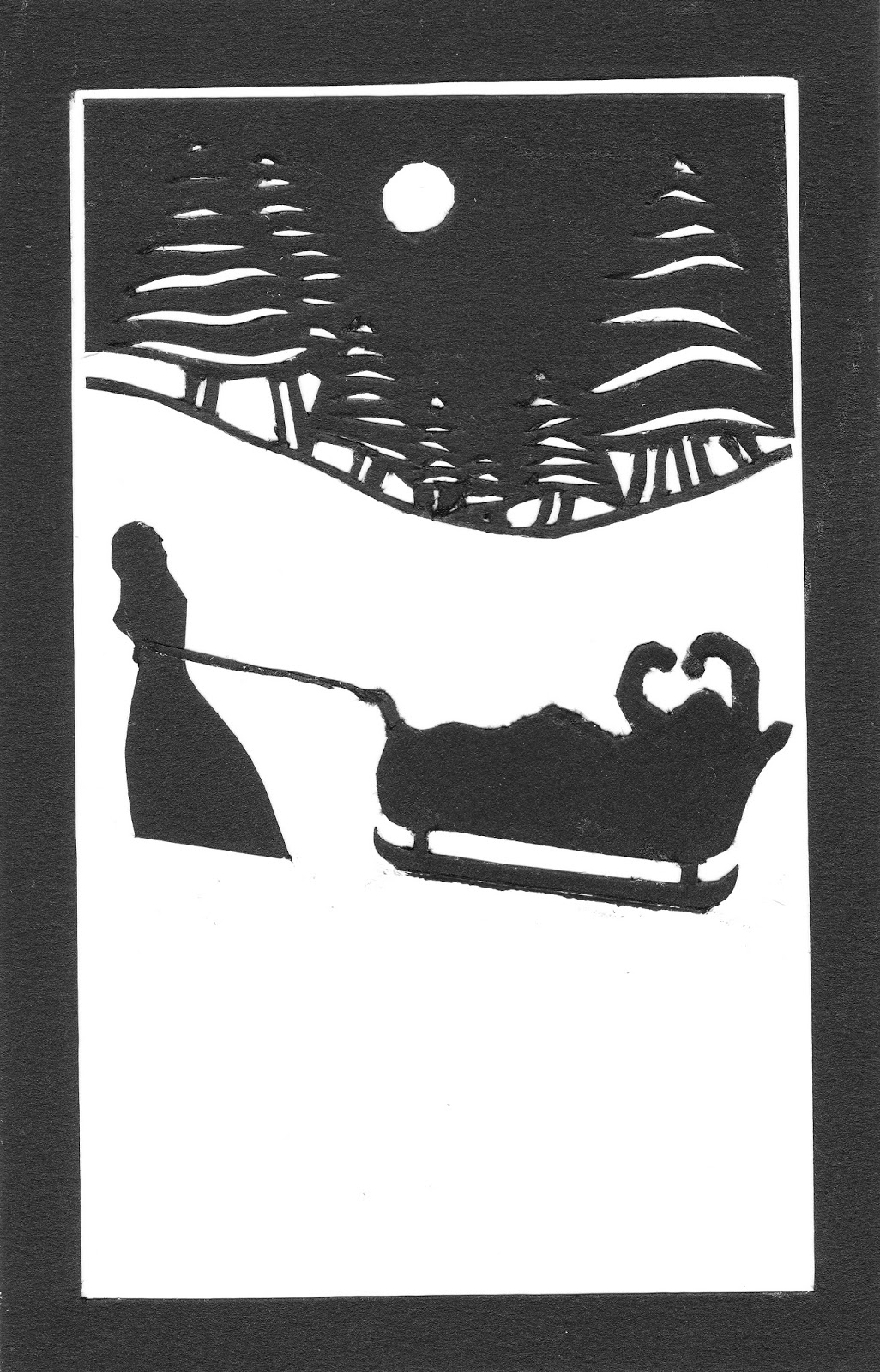
Time passes and still she could not bring herself to open her eyes. Then, she hears the sound of sleigh bells and she knows it is Trypthelda and his reindeer, Minska, pulling his sleigh full of furs and silks over the snow on his way to market. ‘Yes, Trypthelda is a kind man. I could love a man like him’ she thought. And she opened the door of the little cottage where she had been hiding away for a week and a day and she opened her eyes. But it was not Trypthelda that she saw, or Minska, his reindeer, for there before her, pulling the sleigh that he had stolen, was Orlon, the monstrous, hideous and mute hunchback. Of course, Selemia fell deeply in love with Orlon, for she could not see his repulsive face or his hunchback, she only saw the love of her heart and the love of her life. And she went to him and kissed his twisted face as he grunted with happiness. And she took his rough, bleeding hands and led him into the sleigh, covering him in furs and silks to keep him warm. And she pulled the sleigh herself, while Orlon lay fast asleep upon it. She pulled him everywhere, and although he could not speak, she knew that Orlon loved her more than any man, and could give her more love than anyone as vain as Per Baugd.

Over the snow, over the snow,
The Priestess and her sleigh would go.

Years passed and the Priestess and Orlon grew very old together. Yet still she pulled the sleigh. Eventually, poor sick Orlon died, but Selemia, never hearing him ever speak a word, never noticed. And still she pulled the sleigh.
Selemia’s beauty faded until it was only a memory and her fine dress had become thin and worn beneath the fur coat that she wore. Her beautiful long blonde hair was now grey and thin too, and all day she would speak to no one, except Orlon, the love of her heart and the love of her life, whom she pulled everywhere in the sleigh. But she did not know that under the furs and under the silks, heaped with snow, her Orlon was dead and dreaming of her now!
Well, when she discovered poor Orlon, her heart broke and she died too and she was found, still clutching at the hunchback’s bones, lying under the furs and under the silks that were heaped with snow, as much in love in death as she had been in love in life!’
‘What a sad story’ said Peg, ‘I thought it was going to have a happy ending?’
‘It was a happy ending’ Angelica said, ‘don’t you see? Per Baugd’s beautiful face disguised his hideous heart just as Orlon’s grotesque face disguised his beautiful heart. In the end it didn’t really matter. Selemia was beautiful and the hunchback was ugly, but when they became old, they both grew uglier anyway, except Selemia had further to grow in ugliness than him!’
‘But Orlon couldn’t have been very nice if he stole the sleigh!’ said Wot Not.
‘It’s not surprising when someone who has been treated like a monster that they should begin to act like one too!’ said Angelica.
‘Yes, but Selemia had to use magic didn’t she?’
‘And doesn’t that tell you something?’ Angelica said as she looked more and more like an angel. And Pegamina closed her eyes and thought about it for quite some time until she opened them and found herself sitting all alone. She called out ‘Wot Not!’ Angelica!’ but there was no answer. And she saw the broken wings upon the grass and held them. She knew that something was different and changed; she felt it in her heart!


Over the snow, over the snow,
The Priestess and her sleigh would go

PEGAMINA PART ONE


PEGAMINA
By BARRY VAN-ASTEN
 
PART ONE
 
PEGAMINA AND THE DANCING MERMAID

Pretty things were all she thought about, for they reminded her of her mother’s love. When she heard the birds singing, she heard her mother’s soft voice calling to her. When she smelt the pretty flowers growing in the meadow, she smelt the fresh morning fragrance of her mother. When she felt the warmth of the sun upon her face, she felt her mother’s kiss upon her cheek. And each morning as she buttoned up her dress, she would remember how her mother had once held four pearl-white buttons in her hand and said ‘now Pegamina, I will give you the sun and the stars and the world’ and she placed three of the buttons into Pegamina’s hand, saying ‘the fourth I shall keep for myself for it is the moon and one day, you shall have that too!’ And whenever Pegamina looked at the moon in the night sky, she would make a wish and cry for Pegamina missed her mother so much.
When she felt sad her father would say ‘your mother was so kind and gentle Peg that God wanted her to be an angel and although she is not here anymore, she will always be with us in our hearts’. But Pegamina did not understand why her mother could not be an angel and still be her mother.
Poor Pegamina, she was such an unhappy little girl and she found it so difficult to make friends, which made her feel so much alone. And so she lived in her own world of dreams where everything is beautiful and nothing can hurt you. But other children found her strange and called her cruel names until she would cry and want her mother to come and wrap her arms around her and say ‘mother will make it all better’, but she never came.
Sometimes she would sit in the garden, playing by herself and watching the small animals that crossed the lane into the field beyond, and she would whisper: ‘oh fox, I only want to be like other children’. But in her heart she knew that even the gentle creatures that she greeted, silently turned away from her, which hurt her just as much as the horrible names the other children would shout at her. But oh how Pegamina loved the animals.
Like most little girls she was very fond of horses, but Pegamina’s favourite animal in the whole world was the elephant. In fact, when she was small the only thing she would ever draw was elephants: baby elephants, dancing elephants and great tusked giant elephants. She even collected cuddly toy elephants and little elephant statues. But now, she could hardly look at an elephant without bursting into tears, for they reminded her of when her mother would take her into her arms when she felt sad and say ‘my little elephant, Peg?’ and she would begin to tell Pegamina her favourite story, always beginning with how she is a very special little girl, for you see ‘God made all the little animals and when he had finished he sat back and looked upon his creations with great pride. But there was one little elephant in the kingdom who wept day and night for he was such an unhappy elephant; he would go into the forest alone and look at his reflection in the river as the tears rolled down his face, falling into the water. And when God saw this he took pity on the sad little elephant and asked him why he was so sad, and the elephant replied:
‘You have given the nightingale its beautiful song; you have given the tiger its mighty roar; you have given the rhino its distinguishing horn, but what have I? You have given the stag its proud antlers and the leopard its spots and you have given the peacock its handsome tail, but what have I?’ And God looked upon the little elephant and said:
‘It is true that I have given each animal its special gift, and so to you will I give something special, for you see, I cannot have sadness in my kingdom’. And after a moment’s thought, the gift was given. But the little elephant felt no different and said so.
‘Look into the water!’ said God. And the elephant looked, and he saw, waving in front of his face, a huge trunk that he dipped into the water, as tears of happiness ran down it. And the sad little elephant was never sad again.
Pegamina never tired of hearing the story and would prompt her mother if she forgot the slightest detail, or ask for parts of it to be repeated, for she so loved the sound of her mother’s comforting voice. And after the story had been told, she always liked to wonder what it would be like being that little elephant, looking at the sky through its eyes and drinking from the river with its trunk, spraying the water into the air.
On other occasions her mother would sing to her. Most of all Pegamina liked the song about the scarecrow who wanted to see everything in the world, but because he had no legs, he couldn’t even move so much as a step, and so he had to dream what the world is like:
 
‘My back is an old wooden pole,
My chest is a bundle of straw;
Here I stand between pastures that roll,
Yet my dreams show me so much more...
 
I want to see how children play
But my eyes are black and worn.
I want to rise from this forest of hay
Where I fight with my days in the corn!
 
I want to see rivers that endlessly flow
Towards some distant shore;
I want to be free for I have to know
Why crows don’t scare, no more!
 
I want to see flowers and blossoms and blooms
And smell more than harvested hay;
To talk about art in elegant rooms
And not stumble with which words to say!
 
I want to see so much more than I do,
Where nature’s dreams collide...
To trample my limbs in the luminous dew
Where angel eyes have cried!
 
My back is an old wooden pole,
My chest is a bundle of straw;
No heart in my breast nor no soul
Can give me these things I wish for!’

But most of all Pegamina liked to hear the story about the broken-hearted mermaid who had only one desire in life and that was to dance like a ballerina. But how can a mermaid dance when there is a tail where legs should be?
One moonlit night, as the mermaid sat singing some sad and beautiful tune beside a rock, the wind began to blow around her and through her long golden hair as it whispered into her small sea-shell-like ear: ‘why are you singing such a sad song when you are so beautiful that even the moon is envious of your beauty?’ And the mermaid replied: ‘I am sad, for I am tired of the sea and all it contains, my only true desire is to dance and be a ballerina, admire by all who come and see me’. And the wind said ‘beautiful mermaid, you are what you are, can’t you be happy with that?’ And the tearful mermaid replied, ‘I have tried all my life to be content with the sea, but I don’t like who I am or what I have become!’ ‘Then I shall give you all that you desire!’ the wind said, ‘but you must promise never to return to the sea, for I would not see your beauty altered, and in granting your wish, a star must die! Tell me, do you still wish?’
‘I wish!’ said the mermaid. And the air grew still and the sea grew calm as she trembled and swam slowly towards the shore. And then, from the foam she rose on the most beautiful legs you could ever imagine and all she could do was admire them in the moonlight. Then suddenly, she took a step, and then another, until eventually she was twirling, first this way, then that way, upon her toes. And then she stood upon one leg with her arms in the air, bringing her perfectly arched leg down to rest beside the other, as she made the most beautiful movements across the sand; more beautiful than the waves had ever been, or the dolphins under the sea. And she danced until she was gone, far from the sea and happier than she had ever been before, and only a little sad for the death of a star. And Pegamina would often think about the mermaid and wonder if she would ever stop dancing.


The Dancing Mermaid